Hello tea friends, it's your webmaster here.
One of the most common questions I get from newcomers is: “Why is Pu-erh tea divided into raw and ripe? Which one is better?”
Today, I'm going to break it down in the simplest way possible, covering history, processing, flavor, and storage. By the end, you'll never be confused again.
1. The Origin: Ripe Pu-erh Was Born to Imitate Aged Raw Pu-erh
To understand the split, we have to go back a few decades.
Traditional Pu-erh was always raw Pu-erh (sheng) . Farmers would pick leaves, kill-green, roll, and sun-dry them to make maocha (rough tea), then press it into cakes. Time would do the rest: after years or decades of natural aging, the tea liquor would turn red, the bitterness would fade, and a deep aged aroma would emerge. That’s the charm of old raw Pu-erh.
But here’s the catch:
By the 1970s, tea houses in Hong Kong had a huge demand for that aged raw Pu-erh flavor—but natural aging was way too slow.
So Yunnan tea factories started experimenting: Could they mimic the taste of aged raw Pu-erh artificially?
They looked at the "pile-fermentation" (wo dui) technique used in Hunan dark tea and adapted it to Yunnan maocha. By piling up the tea, sprinkling water, and covering it to let microorganisms generate heat, they could achieve in weeks what nature took years to do.
That’s how ripe Pu-erh (shou) was born.
In short: ripe Pu-erh is an industrial imitation of aged raw Pu-erh.
Raw Pu-erh is the traditionalist; ripe Pu-erh is the innovator.
2. Processing: Nature vs. Human Intervention
| Aspect | Raw Pu-erh (Sheng) | Ripe Pu-erh (Shou) |
|---|---|---|
| Core process | Fresh leaf → fixation → rolling → sun-drying | Sun-dried maocha → pile-fermentation → drying |
| Fermentation type | No artificial fermentation; ages naturally over time | Artificial wo dui (accelerated post-fermentation) |
| Time to drink | Drinkable young, but best after years of aging | Drinkable immediately after production |
| Dry leaf color | Dark green, silvery tips | Reddish brown, golden tips |
| Liquor color | Young: yellow-green; aged: orange-red | Deep red, bright, like wine |
Bottom line: Raw Pu-erh is essentially sun-dried green tea that can age; ripe Pu-erh is a post-fermented dark tea (by process).
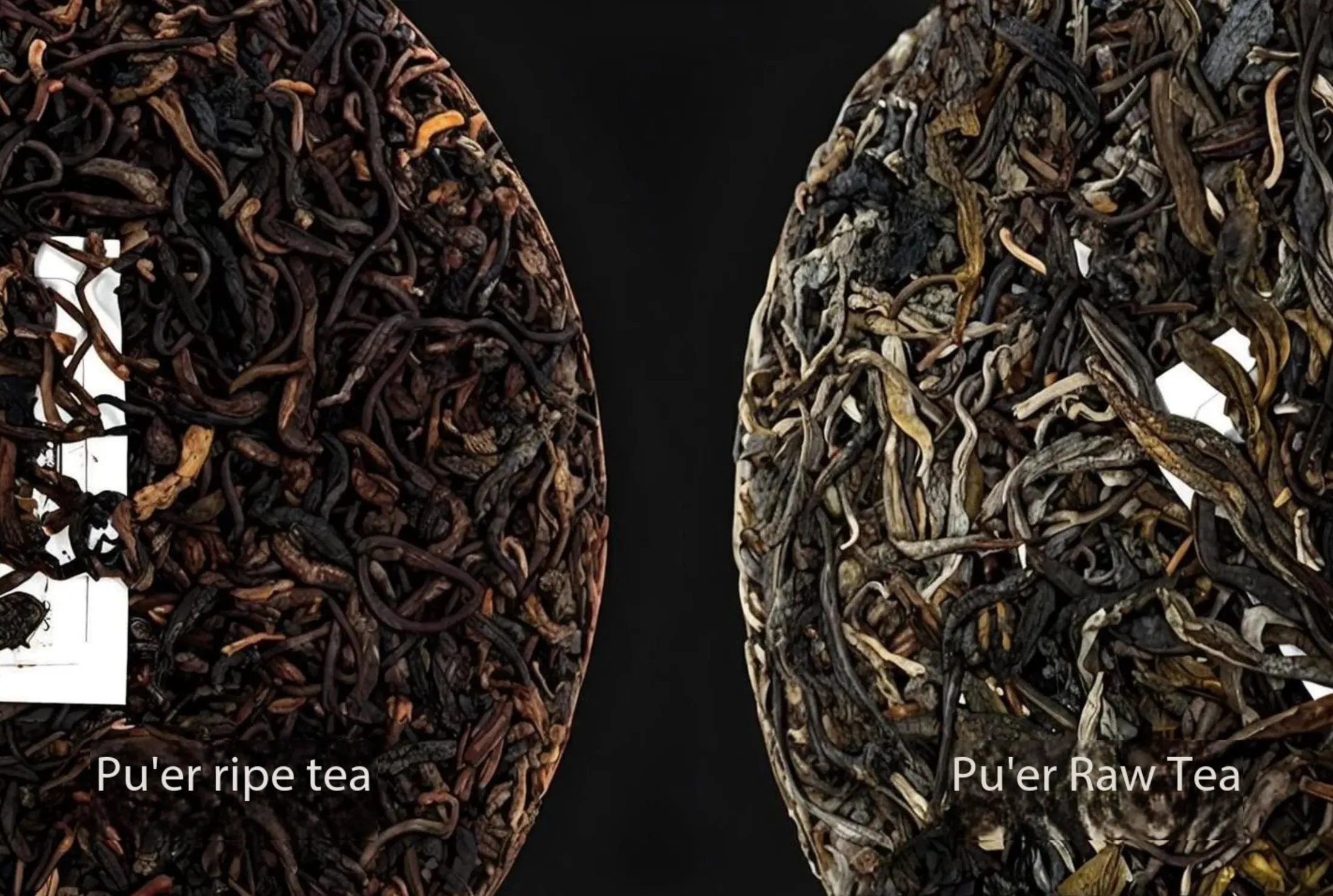
3. Flavor Profiles: Night and Day
Raw Pu-erh: Fresh and Lively, Like a Youth
- Aroma: Floral, fruity, honey-like; sometimes grassy when very young.
- Taste: Fresh, brisk, with noticeable bitterness and astringency that quickly transforms into a sweet aftertaste (hui gan).
- Body feel: Strong tea energy (cha qi); can make your back warm and mind alert.
Ripe Pu-erh: Mellow and Warm, Like a Seasoned Gentleman
- Aroma: Earthy, woody, jujube-like, nutty; new ripe Pu-erh may have a "wo dui" smell (like compost) that fades with short storage.
- Taste: Almost no bitterness or astringency; thick, smooth, velvety, almost like rice soup.
- Body feel: Gentle on the stomach, great after meals, perfect for cold weather.
4. Aging Potential: Raw Is a Growth Stock, Ripe Is a Blue Chip
Many tea lovers care about "the older, the better." Raw and ripe behave very differently in storage.
- Raw Pu-erh: Young raw tea can be harsh, but over time, chemical changes soften the bitterness, deepen the color, and develop complex aged aromas. Well-stored old raw Pu-erh is highly prized and offers unique flavors.
Storing raw Pu-erh is like investing in a growth stock—it requires patience but can yield amazing returns. - Ripe Pu-erh: Because it's already undergone pile-fermentation, it's ready to drink immediately. Storage mainly helps dissipate any remaining wo dui smell and makes the taste even smoother. The flavor evolution is less dramatic than raw Pu-erh.
Ripe Pu-erh is like a blue-chip stock—stable, predictable, and enjoyable right away.
5. Which One Should You Drink? Webmaster's Tips
| Situation / Person | Raw Pu-erh Suits Better | Ripe Pu-erh Suits Better |
|---|---|---|
| Beginner | Might find it too bitter; start with mild raw | Gentle, easy to like |
| Experienced drinker | Loves complexity, tea energy, aging potential | Loves smoothness, comfort, digestive benefits |
| Season | Spring & summer — refreshing | Autumn & winter — warming |
| Stomach sensitivity | Avoid young raw; aged raw is okay | Very gentle, even for sensitive stomachs |
| Desire to age tea | Enjoys watching tea transform over years | Prefers ready-to-drink, minimal storage fuss |
Webmaster's advice:
- If you're a beginner, start with a reputable ripe Pu-erh—it's hard to go wrong and easy to enjoy.
- If you want to experience the magic of aging, buy some quality raw Pu-erh, store it properly, and taste it once a year to witness its journey.
- Why choose? Keep both at home and drink according to your mood and the weather.
6. Conclusion: Two Types, Two Purposes
Pu-erh is divided into raw and ripe to satisfy different needs:
- Some love the freshness, evolution, and collectibility of raw Pu-erh;
- Others prefer the mildness, immediacy, and stomach-friendly nature of ripe Pu-erh.
Ripe Pu-erh was a brilliant innovation to deliver aged-like flavor quickly, while raw Pu-erh preserves the traditional craft and the thrill of aging.
So stop asking which is better—the best one is the one you enjoy most.
Next time someone asks you why Pu-erh has raw and ripe, you can just send them this article and say, "It's basic tea knowledge."
