1. Straight to the Point: Is Pu-erh a Dark Tea?
If you mean Ripe Pu-erh (Shou Pu-erh) → YES, it belongs to the Hei Cha (Dark Tea) category.
If you mean Raw Pu-erh (Sheng Pu-erh) → NO, it is sun-dried green tea that only resembles dark tea after decades of aging.
I know some veterans will disagree, but let the process speak.
2. What Defines Hei Cha (Dark Tea)?
Dark tea is not about the dry leaf color — it’s about the pile-fermentation (wo dui).
Fresh leaves are dampened, piled up, and covered. Microorganisms heat up the pile, turning green leaves into brownish-red, creating that earthy, mellow flavor. This is post-fermentation.
Typical Hei Cha:
- Anhua Hei Cha (Hunan)
- Sichuan Bian Cha
- Hubei Lao Qing Zhuan
- Guangxi Liu Bao
- Shaanxi Jingyang Fu Zhuan
All these go through compulsory pile-fermentation.
3. Pu-erh: Two Faces, One Name
Ripe Pu-erh (Shou) — The “Son” of Hei Cha
In 1973, Yunnan factories learned pile-fermentation from Hunan dark tea and applied it to sun-dried Mao Cha.
Ripe Pu-erh IS dark tea — just a Yunnan-style improvement.
Raw Pu-erh (Sheng) — Green Tea in Disguise
Processing: fresh leaf → fixation → rolling → sun-drying.
No pile-fermentation, no dark tea. Period.
So why do people call it dark tea? Because it ages. After 10–20 years, its color and taste mimic aged dark tea.
But aging is storage, not processing. Without wo dui, it’s still green tea.
4. The National Standard Twist
In 2008, China’s Geographical Indication Product – Pu-erh Tea standard defined Pu-erh as tea made from Yunnan large-leaf sun-dried green tea within a specific region.
It avoided classifying Pu-erh into any of the six tea types, essentially giving Pu-erh an independent status.
Thus, officially, Pu-erh is just “Pu-erh”.
But in academic tea science, ripe Pu-erh = dark tea; raw Pu-erh = green tea (or special aged tea).
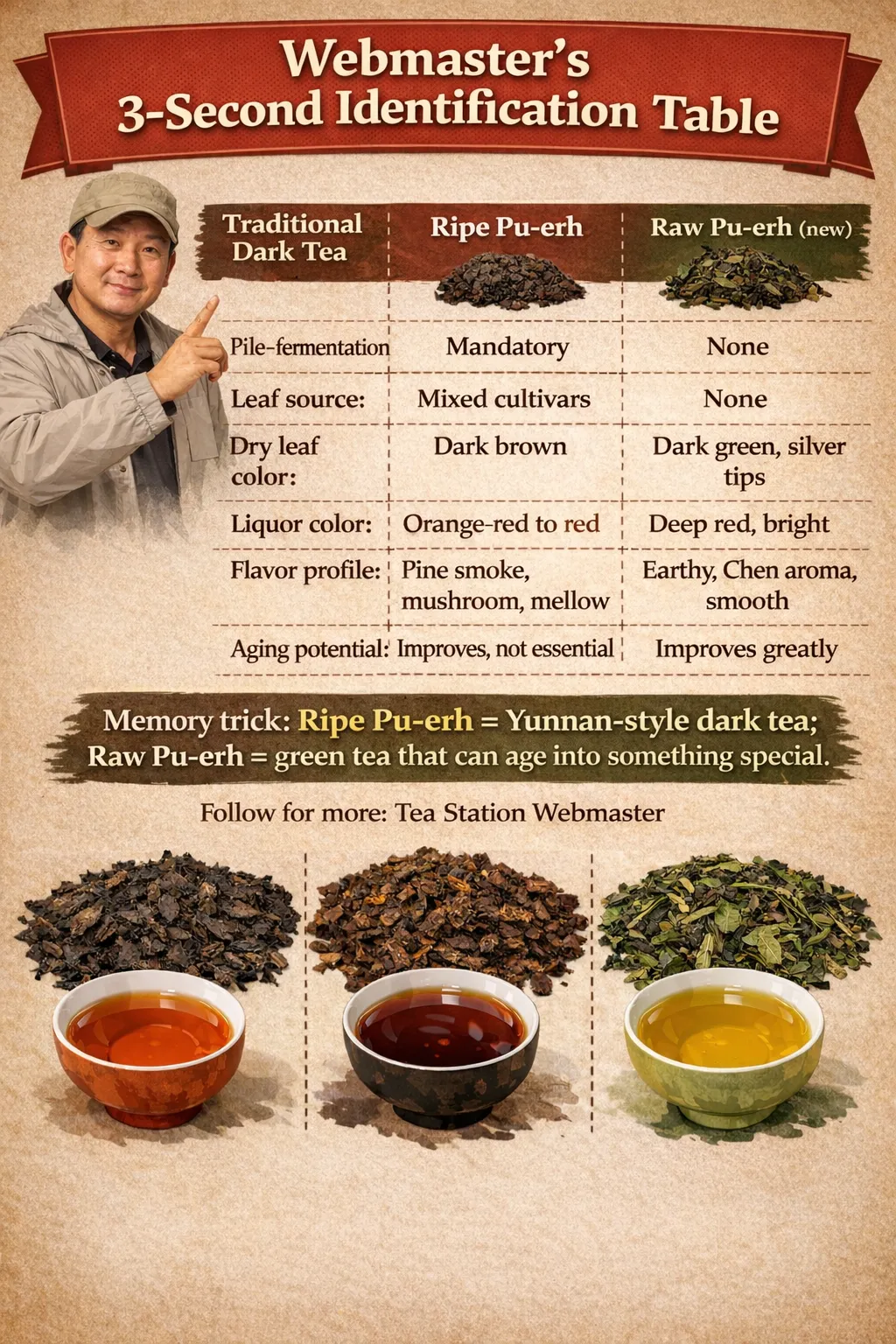
5. Webmaster’s 3-Second Identification Table
| Aspect | Traditional Dark Tea | Ripe Pu-erh | Raw Pu-erh (new) |
|---|---|---|---|
| Pile-fermentation | Mandatory | Artificial wo dui | None |
| Leaf source | Mixed cultivars | Yunnan large-leaf | Yunnan large-leaf |
| Dry leaf color | Dark brown | Reddish brown | Dark green, silver tips |
| Liquor color | Orange-red to red | Deep red, bright | Yellow-green |
| Flavor profile | Pine smoke, mushroom, mellow | Earthy, Chen aroma, smooth | Fresh, astringent, sweet aftertaste |
| Aging potential | Improves, not essential | Improves greatly | Improves greatly |
Memory trick: Ripe Pu-erh = Yunnan-style dark tea; Raw Pu-erh = green tea that can age into something special.
6. Conclusion: Stop Asking “Are They the Same”
Hei Cha is a category; Pu-erh is a specific product.
- Ripe Pu-erh: Belongs to Hei Cha — same process, similar taste.
- Raw Pu-erh: NOT Hei Cha — different process, valued for freshness and aging potential.
- Aged Raw Pu-erh: Tastes like dark tea, but academically remains non-dark tea.
Webmaster’s advice: When buying tea, don’t get hung up on classification. Ask: Is it ripe or raw? Is it pile-fermented or naturally aged? That’s where the real difference lies.
