Tea friends, this is the Site Owner.
After our last deep dive into "What does fermentation mean in tea," my inbox exploded. Many of you asked: "So fermentation IS oxidation, right?" "If black tea relies on enzymic oxidation, why do we still call it 'fully fermented'?"
These questions hit the bullseye. They touch on a scientific truth that has been buried under a century of convenient terminology.
Today, let's pick up where we left off. We're going to tear down the paper screen and formally grant "fermentation" and "oxidation" a divorce in the world of tea.
The Site Owner's core conclusion is crystal clear: Among the six tea categories, with the sole exception of dark tea (hei cha), what the industry calls "fermentation" is, in essence, "enzymic oxidation." They are not the same thing, and we must understand the difference.
1. First, Hard Definitions: These Two Words Come from Completely Different Families
To determine if they are the same, we must return to etymology.
What is oxidation?
Oxidation is a chemical reaction between a substance and oxygen. A sliced apple turning brown, an iron nail rusting, autumn leaves changing color – these are oxidation. In tea, it is the tea leaf's own polyphenol oxidase, activated upon cell rupture, that catalyzes the reaction between polyphenols and oxygen, generating theaflavins and thearubigins.
Keywords: Self-enzymes, oxygen, chemical reaction.
What is fermentation?
Fermentation is a metabolic process of organic matter decomposition carried out by microorganisms. Yeast converting sugar to alcohol, lactic acid bacteria turning sugar into lactic acid, Aspergillus breaking down starch into amino acids – this is fermentation.
Keywords: Exogenous microbes, metabolism, biological transformation.
Thus, in the dictionaries of biology and food science, "oxidation" is a chemical reaction; "fermentation" is a life process. They have never been synonyms. They were forcibly "married" in the tea industry over a century ago.
Site Owner's Straight Talk: This is like calling both "rain" and "a sprinkler truck" by the same word – "water-spraying." The surface phenomenon looks similar, but the essence is worlds apart.
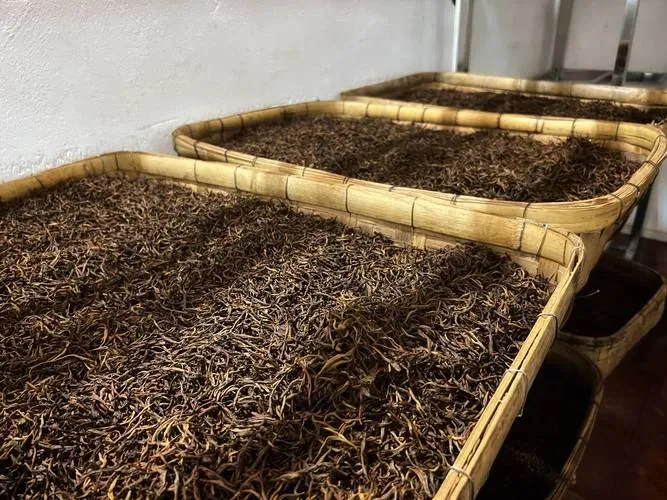
2. The Tea World's "Real vs. Fake Fermentation" Comparison Chart
To make this crystal clear, I've spent days distilling this into an identity card. Read this table, and you'll grasp the logical foundation of all tea classification.
| Dimension | Enzymic Oxidation (Trade jargon: "fermentation") | Microbial Fermentation (True fermentation) |
|---|---|---|
| Essence | Chemical reaction | Life activity |
| Catalyst | Tea's own polyphenol oxidase, peroxidase | Exoenzymes secreted by exogenous microbes (Aspergillus, yeast, Penicillium) |
| Trigger | Cell damage (rolling/bruising) + oxygen + humidity | Piling (wo dui) + high humidity + inoculation or natural enrichment |
| Energy | No energy generation; no microbial growth | Microbes gain energy; cell proliferation occurs |
| Product signature | Theaflavins, thearubigins (bright liquor, brisk taste) | Gallic acid, statins, polysaccharides (dark liquor, mellow body) |
| Representative teas | Black tea (fully oxidized), Oolong (semi-oxidized), White tea (micro-oxidized) | Ripe Pu-erh, Fu brick, Liubao, Qing brick |
What does this table tell us?
Black tea, Oolong tea, White tea – they are not "fermented" at all. They are "oxidized."
Dark tea (ripe Pu-erh, Fu brick, Liubao) – it is the ONLY tea category in the six that truly deserves the name "fermented tea" .
3. Black Tea: The Century-Old Victim of the "Fully Fermented" Misnomer
Let's dissect black tea as our specimen.
Black tea processing flow: Withering → Rolling → Fermentation → Drying.
What actually happens during this so-called "fermentation" step?
- Rolling ruptures cells; the tea leaf's own polyphenol oxidase escapes from the cell walls;
- The enzyme grabs tea polyphenols (catechins), and with oxygen's help, cleaves and reassembles them;
- Theaflavins (golden, bright) and thearubigins (red, mellow) are generated;
- Chlorophyll degrades; grassy aroma dissipates; floral, fruity, and honey notes emerge.
Now tell me: In this entire process, which step requires microbial participation?
None. From start to finish, it's the tea leaf oxidizing itself.
Official agricultural extension documents from Taiwan are unambiguous: The purpose of "fermentation" in black tea processing is to oxidize the catechins in the leaves, turning the leaf color from green to copper-red, and generating the characteristic flavor and aroma . Not a single mention of microbes.
Thus, black tea should be called – fully oxidized tea. Calling it "fully fermented" for a century is a deeply entrenched misnomer.
4. Dark Tea: "Sorry, I'm the Only Legitimate Child"
So, is there truly fermented tea? Yes. Dark tea is the ONLY genuinely fermented tea among the six major categories .
Take ripe Pu-erh's wo dui (piling) process:
- Sun-dried raw tea is sprinkled with water, piled high, and covered to create a hot, humid environment;
- Aspergillus niger, yeast, Penicillium from the air move in;
- They proliferate massively, secreting extracellular enzymes – cellulase, pectinase, polyphenol oxidase;
- These enzymes thoroughly decompose and reconstruct the tea leaves – polyphenols plummet, polysaccharides dissolve, gallic acid emerges;
- This process takes anywhere from 45 days to several months.
This is true fermentation – born from the same mother as winemaking, yogurt culturing, and bread leavening.
This is precisely why academia designates dark tea's process as post-fermentation, distinguishing it from the enzymic oxidation of the other five categories.
5. What About Oolong's "Semi-Fermentation"? It's Semi-Oxidation.
Many ask: Oolong involves both "zuo qing" (bruising) and "sha qing" (fixation). What is it?
Oolong is the textbook case of "semi-oxidation."
- Zuo qing (shaking + resting): Leaf edges are bruised and damaged; oxidation begins at the rims, creating the iconic "green leaves with red edges". This is localized enzymic oxidation.
- Sha qing (fixation): High heat deactivates enzymes, forcibly terminating oxidation. This is why Oolong retains substantial green portions, with oxidation levels controlled between 15% and 70%.
Thus, Oolong is neither "fully" nor "semi" fermented – it is a masterclass in controlled oxidation.
6. Then Why Do We Still Perpetuate This Misnomer?
You might ask: Site Owner, if it's wrong, why don't we just correct it?
Because language is a matter of convention.
For over a century, generations of tea masters have passed down their craft using the word "fermentation." Asking a 50-year veteran black tea maker to suddenly switch to "oxidation" would not only confuse him – he'd probably tell you off.
The academic world takes a very pragmatic stance: The misnomer is entrenched, but we must be clear-minded about the science.
When English literature addresses this, it explicitly notes: teas are oxidized, not fermented, although the term "fermentation" remains common in the trade. This is a historical misnomer .
So, by all means, continue calling black tea "fully fermented" in casual conversation. But you MUST know: its essence is fully oxidized.
7. Final Summary: Fermentation vs. Oxidation – One Chart to Rule Them All
| If you're discussing… | It's actually… | Representative Teas | Key Process |
|---|---|---|---|
| Green "non-fermented" | Non-oxidized | Longjing, Biluochun | Fixation (enzyme kill) |
| White "micro-fermented" | Micro-oxidized | Silver Needle, Bai Mudan | Withering (slow oxidation) |
| Yellow "lightly fermented" | Light oxidation + non-enzymic browning | Junshan Yinzhen, Huoshan Huangya | Sealed yellowing (moist-heat oxidation) |
| Oolong "semi-fermented" | Semi-oxidized | Tieguanyin, Yancha, Dancong | Bruising (controlled oxidation) |
| Black (Hong Cha) "fully fermented" | Fully oxidized | Keemun, Dian Hong, Darjeeling | Rolling + oxygenation (complete oxidation) |
| Dark (Hei Cha) "post-fermented" | TRUE microbial fermentation | Ripe Pu-erh, Fu brick, Liubao | Piling (microbial metabolism) |
So, are fermentation and oxidation the same thing in tea?
My answer: In the world of tea, they are two different liquors poured into the wrong bottles. The bottles labeled "fermentation" for black, oolong, and white teas actually contain "oxidation." The bottle labeled "fermentation" for dark tea contains the real thing. The labels are identical; the contents are worlds apart.
As a tea drinker, you don't need to mentally recite chemical equations with every sip. But you should at least know this:
- When you drink black tea, you are tasting the tea leaf's own collaboration with oxygen.
- When you drink ripe Pu-erh, you are tasting the metabolic life's work of millions of microorganisms.
Remember the Site Owner's words: The longest distance in tea science isn't between black tea and green tea. It's between the word "fermentation" as used for black tea, and the same word as used for dark tea. They inhabit two separate universes.
Grasp this distinction, and you already understand tea better than 90% of drinkers out there.
