Tea friends, this is the Site Owner.
Have you ever found yourself in this awkward situation: holding a package of Anji Bai Cha, you confidently ask the shop owner, “This is white tea, right?” – only to be met with a knowing smile. Or you see the word “red” in Da Hong Pao and firmly believe it’s black tea (red tea), only to have a seasoned tea drinker silently shake their head. Don’t be embarrassed. Almost everyone steps into this trap.
A tea named after a color does not mean it belongs to that tea category. So here’s the question: What exactly is the standard for classifying the six tea categories – green tea, white tea, yellow tea, oolong tea (qing cha), black tea (hong cha), and dark tea (hei cha)? Is it color? Fermentation degree? Or something else?
Today, let’s trace the “ID card” of tea from beginning to end. By the time you finish this, you won’t just be able to classify teas with confidence; you’ll also be able to recount this history clearly at any tea table.
1. Before Chen Chuan: The “Warring States Period” of Tea Classification
In ancient times, tea classification was basically “seeing is believing.”
Lu Yu’s The Classic of Tea in the Tang Dynasty recorded “coarse tea, loose tea, powdered tea, cake tea” – classified by form. The Song Dynasty distinguished “piece tea” and “loose tea” – classified by whether it was compressed. The Yuan Dynasty divided tea into “bud tea” and “leaf tea” by tenderness. By the Ming Dynasty, names like green tea, yellow tea, dark tea, white tea, and black tea had appeared, but these were empirical labels – neither uniformly defined nor capable of explaining the essential differences between them[citation:6].
In modern times, the confusion only grew: some classified by season (spring tea, summer tea, autumn tea), some by origin (Keemun black tea, Yunnan green tea, Wuyuan green tea), some by sales channel (domestic, export, border trade, overseas Chinese)[citation:9]. All these methods had merit, but none were universal. A tea could be both spring-harvested, Keemun-produced, and export-oriented – which category should it belong to?
Site Owner’s Take: Tea classification back then was like traveling without a map. You could still move forward, but you never knew if you were on the right road.
2. Chen Chuan’s Foundation: A Revolution from “Flavanol Content” to “Processing and Quality”
In 1978, a name must be etched into the history of Chinese tea science: Professor Chen Chuan of Anhui Agricultural University, one of the founders of China’s higher education in tea studies.
In his paper “The Theory and Practice of Tea Classification,” he accomplished something of profound significance: for the first time, he used modern scientific methods to establish a complete, systematic, and logically coherent classification system for Chinese tea[citation:6].
What was Chen Chuan’s core theory?
In simple terms, two sentences:
- Based on the oxidation degree of tea polyphenols (then called flavanols) during processing;
- Grounded in changes in processing methods and quality characteristics, revealing the progression from quantitative to qualitative transformation[citation:6].
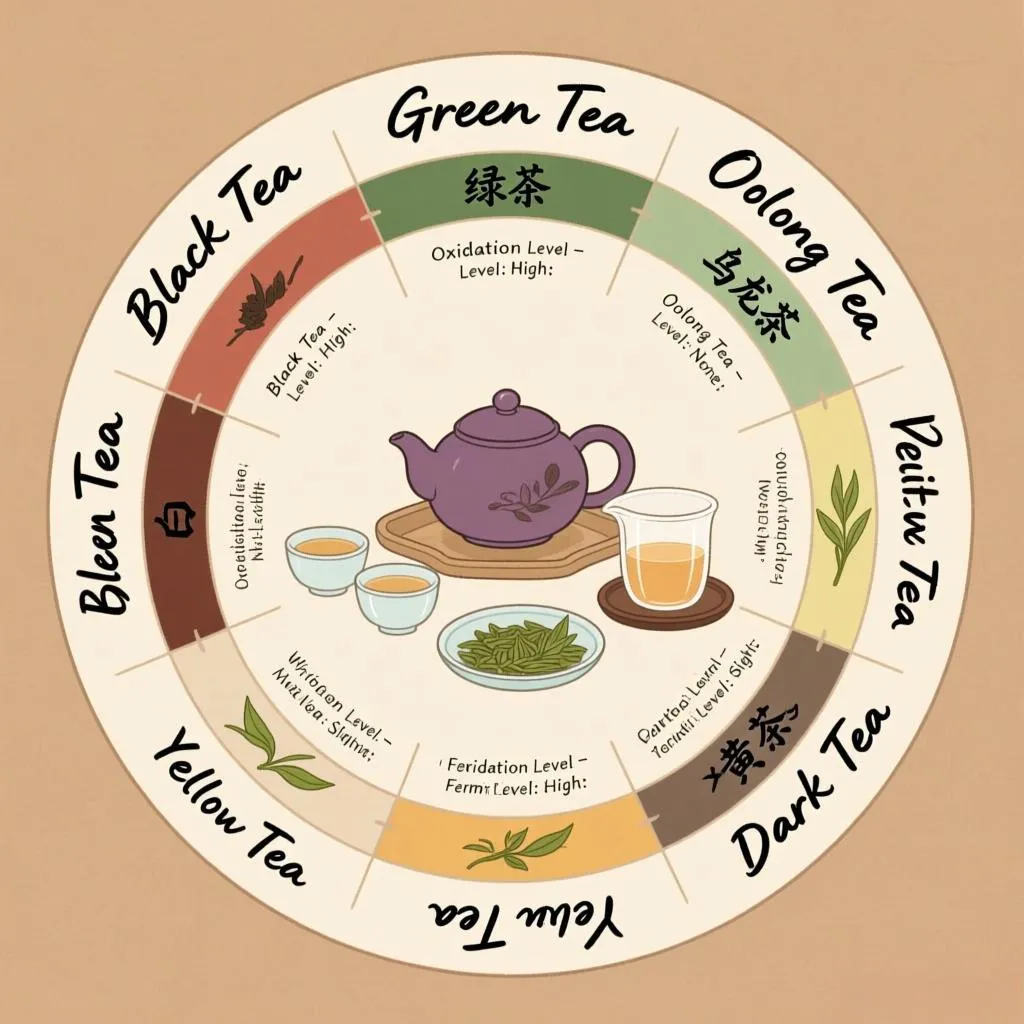
He divided tea into six categories, arranged from lowest to highest oxidation: green tea, yellow tea, dark tea, white tea, oolong tea, black tea.
This sequence was not arbitrary. It corresponds to the full spectrum of how tea’s internal compounds are awakened and transformed during processing:
- Green tea: Non-oxidized, enzyme-killed by fixation, retaining its original character.
- Yellow tea: Slightly oxidized, the “men huang” (sealed yellowing) process creates yellow leaves and yellow liquor.
- Dark tea: Post-fermented, microbial involvement, nature turns温和.
- White tea: Lightly fermented, naturally oxidized during withering, no killing or rolling.
- Oolong tea: Semi-oxidized, the “zuo qing” (bruising) process creates the characteristic “green leaves with red edges.”
- Black tea: Fully oxidized, enzymatic oxidation complete, red liquor and red leavescitation:3.
Site Owner’s Analysis: Chen Chuan’s greatness lies not in “inventing” these tea categories – they already existed. His greatness lies in discovering the internal logical connections between them, stringing scattered pearls into a clear value chain.
3. National Standard Establishment: From “Academic Theory” to “Legal Language”
Theory was established, but implementation required standardization.
2014 was a pivotal year. The national standard GB/T 30766-2014 “Tea Classification” was officially releasedcitation:2.
What were the core contributions of this standard?
First, it defined the overarching principle of classification: Based on processing technology and product characteristics, combined with tea plant variety, fresh leaf material, and production region[citation:8].
Second, it provided legally defined terms for 15 core concepts. What is “fixation”? What is “sealed yellowing”? What is “piling”? What is “bruising”? – Clearly written, nationally applicable[citation:8].
Third, it systematically established secondary classifications for the six tea categories:
- Green tea: Pan-fried, baked, sun-dried, steamed
- Black tea: Broken black tea, Gongfu black tea, Lapsang Souchong
- Yellow tea: Bud type, bud-leaf type, multi-leaf type
- White tea: Bud type, bud-leaf type, multi-leaf type
- Oolong tea: Southern Fujian, Northern Fujian, Guangdong, Taiwan, other regions
- Dark tea: Hunan, Sichuan, Hubei, Guangxi, Yunnan, other regions[citation:8]
Site Owner’s Take: The significance of this national standard is that it issued a nationally recognized ID card to Chinese tea. Before, if you said “this is oolong tea,” ten people might have ten different interpretations. Now, the processing method, quality characteristics, and classification code are all clearly documented – no ambiguity remains.
4. International Consensus: From “Chinese Standard” to “Global Language”
For Chinese tea to go global, self-identification is not enough. International recognition is essential.
2023: A milestone year. The ISO 20715:2023 “Tea – Classification” international standard, led by Professor Wan Xiaochun of Anhui Agricultural University, was officially released[citation:1].
What does this mean?
The six-category classification system has officially become international consensus. From this point forward, green tea is green tea, black tea is black tea – not subject to arbitrary labeling[citation:1].
The core content of this standard aligns with GB/T 30766-2014:
- Classification based on processing technology and quality characteristics;
- Tea divided into six categories: black tea, green tea, yellow tea, white tea, oolong tea (qing cha), and dark tea;
- Terminology for distinctively Chinese key processes such as “shaping,” “sealed yellowing,” and “piling” formally defined[citation:1].
2025: Another victory. ISO/TS 5617:2025 “Tea – Chemical classification” was released. This standard approaches classification from chemical composition, selecting six key discriminant factors – caffeine, catechins, theanine, and others – to achieve objective, accurate differentiation of the six tea categories using empirical data[citation:7].
Site Owner’s Interpretation: If ISO 20715 is tea’s “processing ID card,” then ISO 5617 is tea’s “chemical genome map.” One external, one internal – a perfect complementary pair. Chinese tea’s voice on the international stage has never been stronger.
5. So, What Exactly is the Standard for the Six Tea Categories?
Now, we can provide a complete, rigorous, and defensible answer.
The classification standard for the six tea categories rests on two pillars:
- Primary Standard (Fundamental): Processing Technology and Quality Characteristics. Were you fixed or withered? Were you yellowed or piled? Are you semi-oxidized or fully oxidized? – Your processing determines your category; your quality characteristics determine whether you represent that category well. citation:1
- Secondary Standard (Auxiliary): Chemical Composition and Discriminant Factors. What are your caffeine levels? What is your catechin profile? What proportion of theanine do you contain? – When processing is ambiguous or disputed, chemical data serves as the final arbiter. [citation:7]
As for “fermentation degree”? That is a result, not a standard. Classifying tea by fermentation degree is like defining whether someone is a humanities or science student by their exam scores – the score is the outcome, the chosen field of study is the essence.
Summary
So, what is the standard for the six tea categories?
My answer: They are classified primarily by “processing technology,” verified by “chemical composition,” and presented through “quality characteristics.”
From Professor Chen Chuan’s groundbreaking 1978 paper, to the 2014 national standard, to the 2023 and 2025 ISO international dual standards – Chinese tea has taken nearly half a century to elevate its classification system into the world’s common language.
This is not an academic exercise confined to libraries. This is the fundamental logic underlying every tea cake, every cup of liquor, every transaction. Which category the tea in your hand belongs to is not determined by its packaging, not by its color or name – it is determined by the processing technology it underwent.
The next time someone asks, “Is Anji Bai Cha white tea?” or “Is Da Hong Pao black tea?” you can send them this article and say, with quiet authority:
“A tea’s category is not in its name, but in its craft. Not in its color, but in its logic.”
Remember the Site Owner’s words: Master the six tea categories, and you’ve grasped the entire skeleton of Chinese tea.
