Tea friends, this is the Site Owner.
In recent years, whenever Pu-erh tea is discussed, the term "Shan Tou" is unavoidable. Lao Ban Zhang, Bing Dao, Bo He Tang, Xi Gui… these names are like legendary divine weapons in martial arts novels. Mention them, and tea lovers' eyes light up—and so do the merchants' price tags. One cake can buy a BMW; one tong can buy an apartment in Guangzhou.
So my inbox is flooded daily: "Site Owner, is Shan Tou tea really worth it?" "If I don't drink Lao Ban Zhang, am I even a real Pu-erh drinker?"
Today, let's shatter this misconception completely. My stance is clear: Shan Tou itself is not a scam, but blindly chasing Shan Tou? Nine times out of ten, it is.
1. First, a Fair Word for Shan Tou Tea
Before I operate, I must give credit where it's due. Not everything labeled "Shan Tou" is a fraud. Good Shan Tou tea does have its genuine value.
The core value of Shan Tou tea rests on three pillars:
- Terroir-identifiable, one mountain one flavor. The boldness of Lao Ban Zhang, the rock-sugar sweetness of Bing Dao, the cool lingering charm of Bo He Tang—this isn't mysticism. It's the flavor fingerprint shaped by different altitudes, soils, microclimates, and tea cultivars. Just like Burgundy's vineyards or Yunnan's specialty coffee, terroir itself is value.
- Ecological accumulation and tree age. Genuine ancient tree Shan Tou tea has roots that penetrate deep, absorbing minerals from subsoil layers. Its inner substance is richer, astringency transforms easily, and the Hui Gan and Sheng Jin are lasting. This is an objectively existing quality difference, not fabricated.
- Objective scarcity. Ancient tree tea accounts for less than 5% of Yunnan's total Pu-erh output. Lao Ban Zhang's ancient tea garden is barely over 4,000 mu; Bing Dao Lao Zhai's core area is the size of a palm. Rarity commands a price—basic economics.
So, if what you're drinking is authentic Shan Tou, genuine ancient trees, and proper craftsmanship, the high price is justified. This isn't a scam. This is paying for terroir, ecology, and scarcity.
2. Then Where's the Problem? – The Four Sources of the "Scam"
What truly saddles Shan Tou tea with the "scam" label isn't the mountains themselves, but four malignant tumors growing around them.
Tumor One: Speculation—Turning Tea into a Financial Product
"One cake can buy a BMW; one tong can buy an apartment in Guangzhou." This isn't a joke; it's actual copy from Douyin videos.
Insiders reveal that many of these "multi-million dollar transaction" clips are completely fabricated, deliberately creating an illusion of scarcity to find the next bagholder. That Lao Ban Zhang cake you spent a fortune on? The farmer who supposedly grew it has never even seen it.
Academician Liu Zhonghua, a member of the Chinese Academy of Engineering, put it bluntly: "The tea industry obsesses over ancient trees and mountain origins, wishing every single tree were unique. This is disorderly development, harming the industry's health."
Tumor Two: Counterfeiting—Your "Famous Mountain" Tea is 90% from the Neighboring Village
A brutal reality: Over 90% of products marketed as "Lao Ban Zhang" or "Bing Dao" are fake.
Tea traders admit: bring tea from Region A to a famous production area, repackage it, and it instantly becomes "core mountain tea" at several times the price. The irony? Some famous mountains set up checkpoints at village entrances every spring harvest to prevent foreign tea leaves from being smuggled in and passed off as local produce. If the locals themselves are terrified of counterfeits, how deep do you think this water runs?
Here's an absurd but telling anecdote: A longtime tea drinker was convinced he loved "Lao Ban Zhang." One day, a shop owner served him the real, authentic Lao Ban Zhang. The customer cursed, claiming it was "fake." The owner then brought out a $3 fake cake. The customer beamed: "Yes! This is the real stuff!" The owner pocketed a hearty profit.
You think you're drinking a famous mountain, but you're just drinking "the famous mountain you believe in." If that's not a scam, what is?
Tumor Three: Information Asymmetry—The Black Box Pricing of Non-Standardized Goods
Tea is an agricultural product, not an industrial one. Without unified quality standards, pricing becomes whatever the seller says it is.
A tea cake costs a few dollars to produce. Stamp "Bing Dao" on the wrapper, and it's suddenly worth hundreds or thousands. Is it worth it? No way to prove it, no way to disprove it. With no standards, consumers can only pay with "trust"—trust in the brand, in a friend, in the story on the package.
The darker side: Some people buy premium Shan Tou tea, don't understand it, are afraid to admit it, and force themselves to say, "Ah yes, this is what fine tea tastes like." Consumers themselves become accomplices in the deception. This is the saddest form of scam.
Tumor Four: You Can't Even Taste the Difference—And That's the Truth
This is the hardest truth to admit, yet the most real: The vast majority of tea drinkers cannot, in a blind test, distinguish Lao Ban Zhang from a well-blended factory tea.
This isn't an insult; it's a fact. An industry veteran with 13 years in the game states plainly: "Being obsessed with tree age is a scam. Older trees don't guarantee higher quality, and high-quality tea doesn't necessarily come from old trees. If someone's first words about tea are about 'hundreds of years,' they probably have nothing substantial to say."
Another professional puts it even more bluntly: "Most tea drinkers cannot taste the difference between ancient tree Pu-erh and regular Pu-erh. Only a very small number of experienced tasters and tea makers can accurately identify the distinction after careful evaluation."
You spend $500 on a "Bo He Tang" cake. Your neighbor spends $50 on a blended tea. In a blind tasting, you probably can't tell which is which. But at the moment you paid, you were absolutely convinced you had already mastered the taste.
If that's not a scam, what is?
3. The Site Owner's Shan Tou Philosophy: Neither Deify Nor Demonize
So, can Shan Tou tea be bought? Of course. But with the right approach.
First, Acknowledge Your Level.
If you've been drinking tea for less than three years and haven't tasted fifty different Pu-erh teas—sorry, you're not ready to chase Shan Tou. It's not that you're unworthy; it's that your current palate simply cannot discern why that $500 tea is better than the $50 one.
Chasing Shan Tou at this stage is mostly "paying for loneliness." Worse, you risk forming incorrect taste memories—mistaking the sweetness of fake Bing Dao as the standard, or dismissing the authentic bitterness of real Lao Ban Zhang as "not genuine."
Second, Distinguish Between "Drinking" and "Collecting."
Shan Tou tea serves two purposes: drinking and aging. My advice to beginners is brutally simple: Drink first, don't collect.
If you can't even remember the flavor of this year's new tea, what business do you have talking about "its transformation after a decade"? That's not collecting; that's gambling.
Third, Respect the Real Thing, But Don't Pay for Fakes.
If you have a trustworthy source, authentic material, and a fair price, by all means, buy a sample of real Lao Ban Zhang or real Bing Dao. This is paying for terroir, investing in your sensory education.
But if you're only buying for the name on the wrapper, for the likes on your social media post—you're not buying tea. You're buying vanity. And vanity is expensive. It's a scam that renews itself indefinitely.
Fourth, Don't Make Shan Tou Your Religion. Blending is Also Wisdom.
Some tea drinkers frown at the word "blending," believing "pure material" is inherently nobler. Congratulations, you've been brainwashed by marketing.
Blending is not adulteration. Blending is the tea master's art of creation. The Dayi 7542 has thrived for decades not because of a single mountain, but because of its recipe. Pure material is nature's gift; blending is human craftsmanship. Neither is superior. If you believe "blended = cheap," you are precisely the kind of consumer most thoroughly harvested by the Shan Tou mythology.
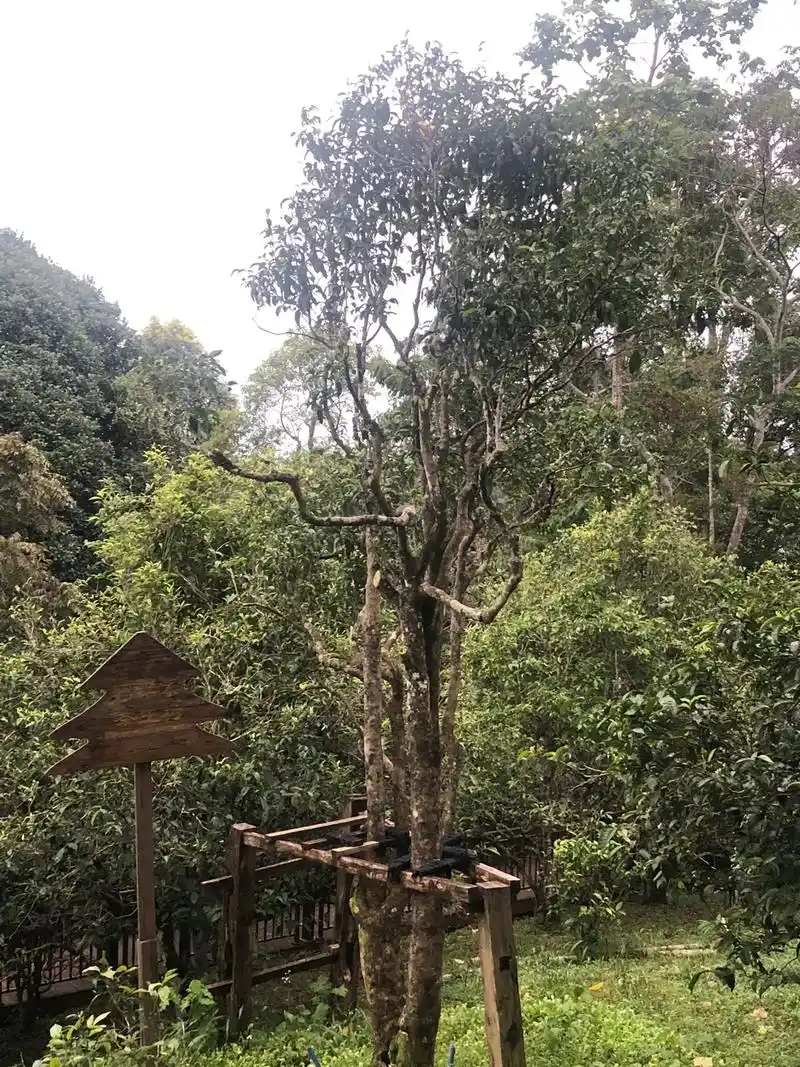
4. The Site Owner's "Three Rules for Shan Tou Survival"
- Sample first, cake later. For any famous mountain, buy a tasting sample first. If you don't "get" it? Congratulations, you just saved a fortune.
- Brands first, niche later. For beginners with limited discernment, well-blended teas from reputable factories are far safer than "obscure mountain" teas from unknown sources.
- Palate first, reputation later. Tea is for drinking, not worshipping. Don't let the name on the wrapper decide whether it tastes good to you.
Summary
So, is Shan Tou tea a scam?
My answer: Shan Tou tea itself is not a scam. It is a legitimate vessel carrying the objective values of terroir, ecology, and scarcity. But the deified mountains, the speculated "financial teas," the counterfeit labels, and the vanity of buying what you cannot even taste—these are scams, through and through.
A true tea connoisseur isn't someone who never buys Shan Tou. It's someone who knows exactly why they're buying it, what they're actually getting, and whether the price matches the value.
Remember the Site Owner's words: Shan Tou tea is an elective course on your tea journey, not a mandatory prerequisite. Don't let it become the first sky-high tuition fee you pay.
