The Awkward Truth: It's Not the Tea, It's You.
Ever noticed this weird phenomenon? Someone who's always in a rush, impatient even waiting for an elevator, can sit at a tea table for hours, watching leaves float, waiting for water to boil.
And they'll tell you: "Tea helps me slow down."
Friend, let's pop that gentle bubble. It's not that tea magically slows you down. It's that your normal life is moving at a insane speed! Tea just gives you a "legitimate" and "classy" excuse to finally stop and breathe.
Today, let's talk about how this cup of leaf water systematically forces you to decelerate.
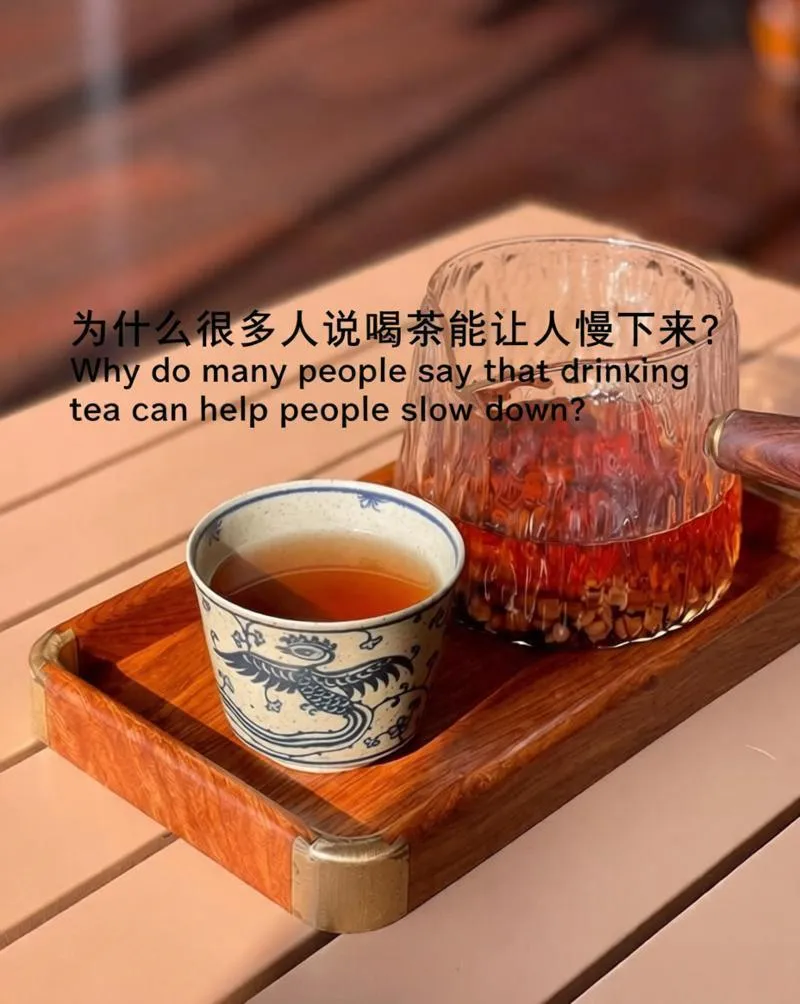
Part 1: The "Physical Brake" – The Enforced Slow-Motion Sequence
Making tea is, by design, a sequence you can't fast-forward. It physically interrupts your rhythm.
Waiting for the Boil (The Forced Pause):
- You can't make water boil instantly. For 1-3 minutes, you just wait. This waiting shifts you from the "I need it now!" task mode to a "I'll wait for it..." standby mode. First gear down.
The Ritual of Brewing (The Precision of Action):
- Warming the vessel, measuring leaves, pouring water, timing the steep... Even simplified, it can't be as "brutal" as tearing open an instant coffee packet. Your movements must be gentle, focused, controlled. This demand for fine motor skills naturally rejects haste.
Small Sips (The Restriction of Intake):
- Tea isn't for chugging. A small cup, hot, requires you to blow, to sip. The repetitive micro-cycle of "pick up - cool - taste - put down" creates a new relationship with your drink: You're not consuming it; you're interacting with it.
In short: The tea routine is like "deceleration calisthenics," using unavoidable micro-steps to yank you from "sprint mode" into "stroll mode."
Part 2: The "Sensory Magnifying Glass" – Pulling You into the Now
Slowing down isn't just about movement; it's about the mind. How does tea do that?
A Visual Anchor:
- Watching leaves unfurl and dance, observing the liquor's subtle color shifts. Your eyes have a gentle, dynamic, thought-free focal point. This is infinitely kinder to your brain than staring at a screen of fragmented information.
Olfactory Immersion:
- Activated by hot water, the aroma instantly fills the space. You instinctively take deep breaths to capture it (smelling the aroma). Deep breathing is, in itself, one of the most effective physiological responses for relaxation and stress relief.
A Taste Adventure:
- Tea isn't just sweet or bitter. You try to discern its notes, feel the returning sweetness (hui gan). This delicate exploration demands you pull all your attention back to your tongue and mouth. In this moment, you can't simultaneously worry about tomorrow's report.
This is the core of mindfulness: Paying attention to the present moment, non-judgmentally. Drinking tea accidentally executes a perfect mindfulness exercise—your eyes, nose, tongue, and hands are all gently "tethered" to the now.
Part 3: The "Psychological Barrier Generator" – Creating a Sacred Space
This is the deepest layer: Tea psychologically draws a protective circle.
Identity Shift Cue:
- The thought "I'm going to make tea" automatically triggers a shift into a third space distinct from "work mode" or "chore mode." Here, efficiency, KPIs, and deadlines are temporarily suspended. You are permitted to "do nothing."
Changing the Texture of Time:
- In fast-paced life, time is a "resource" to be "used," "saved," "chased." At the tea table, time becomes "atmosphere," a liquid to be felt and immersed in. The ten-plus minutes from a strong first steep to a light last one make you feel time's "thickness" and "flow," not its "loss."
Downgraded Social Mode:
- Compared to the noise of a bar or the business of a café, conversation over tea tends to be softer, calmer, deeper. Even comfortable silence is allowed. Here, silence isn't awkward; it's a permitted state of comfort.
This "barrier" works because it's widely recognized. Say "I need a cup of tea to calm down," and the whole world understands and gives you space. It's a precious privilege tea culture grants modern people.
Part 4: The Ultimate Truth of "Slowing Down" – A Micro Rebellion Against Alienation
Here's the uncomfortable bit. Why do we need to consciously "slow down"? Because our normal state has become "alienated."
- We eat while on our phones (alienating nourishment).
- We travel to take check-in photos (alienating experience).
- We even relax by scrolling short videos (alienating rest).
Drinking tea is a minimal, gentle rebellion against the alienation of life.
Through a seemingly "inefficient" ritual, it solemnly declares:
"At this small table, I am not pursuing output. I do not serve efficiency. My sole purpose is to mindfully drink this cup of water and feel every subtle sensation this leaf offers me."
This act, which exists purely for its own sake and your own sensation, feels incredibly luxurious and deeply healing in today's utilitarian world.
Final Verdict: Tea is a "Speed Bump for the Soul" in This Era
So, tea's ability to slow people down isn't mysticism. It's a carefully orchestrated "sensory hijacking" and "psychological暗示."
- Physically: Its process forces you to pause.
- Sensorily: Its flavors lure your focus to the present.
- Psychologically: Its culture carves out a "do not disturb" space-time for you.
It doesn't solve any concrete problem in your life, but it does something more vital: It lets you temporarily climb out of the "whirlpool of problems" and regain calm breath and clear perception. Often, after slowing down, the problem itself hasn't changed, but your mindset and perspective have.
Drinking tea is like paving a cobblestone path for yourself on the highway of life. It's bumpy, but it makes you feel you're walking again.
Next time the world feels too fast and your mind too scattered, don't aim for the grand, vague goal of "I need to slow down." Just do the simplest thing: Boil some water. Make a cup of tea. Let this millennia-old "deceleration program" run its course on you naturally.
True slowness isn't about moving sluggishly, but about the mind taking root in the present with certainty. And this cup of tea might just be the gentlest guide to help you find that soil.
