Hello tea friends, this is the Site Owner. Holding a tea cake, you might have wondered: why go through the trouble of pressing perfectly good loose leaves into cakes, bricks, or tuos? Today, let's travel through time and science, from survival to aesthetics, to fully understand the profound wisdom behind this act of compression.
1. A Historical Imperative: The Needs of Survival and Trade
We must start at the beginning. Pressing tea was initially not for "better taste," but for "survival" and "reach."
- Extreme Space Efficiency: In ancient times, especially during the era of the Tea Horse Road, tea was a crucial trade commodity. Loose tea was bulky; a horse could carry perhaps one-tenth the amount of compressed tea compared to loose. Pressing into cakes and bricks was a monumental innovation in ancient logistics, drastically reducing transport costs and enabling tea to travel across vast distances.
- Facilitated Long-Distance Transport: The compact form significantly reduced breakage from jostling and offered better moisture resistance than loose tea, making it ideal for long, damp trade routes.
- The Dawn of Standardization: Standardized forms and weights—like the 357-gram cake (bing), 250g or 1000g brick (zhuan), and 100g or 250g tuo—made measuring, pricing, and trading easier. This was an early form of tea commodification.
The Site Owner's Perspective: The origin of tea pressing showcases the ultimate pragmatism of our ancestors in the face of harsh nature and vast distances. This is the wisdom of survival.
2. A Scientific Reward: The Unexpected Miracle of Transformation
Historical necessity led to a flavorful serendipity. People later discovered that pressed tea not only transported well but often tasted remarkably better after years of storage. This leads to the second core reason:
Creating a Stable "Micro-Fermentation Environment":
- Loose tea, with full air exposure, transforms rapidly and unevenly, often losing aroma and flavor too quickly.
- The interior of a tea cake forms a relatively sealed, stable micro-climate. Transformation proceeds slowly and evenly from the outside in, shifting from dominant oxidation to a more complex "post-fermentation" involving microbial activity.
Guiding Directed Flavor Transformation:
- This slow, communal fermentation more effectively promotes the transformation of tea polyphenols, the breakdown of cellulose, and the polymerization and creation of various aromatic compounds.
- The resulting taste profile is often characterized by: reduced astringency, and a broth that becomes more mellow, smoother, and more velvety, with complex layers of flavor. It can develop sophisticated aroma notes like "aged fragrance," "herbal notes," or "date sweetness," which are difficult to achieve in loose tea.
- Preserving the Tea's Substance: The compressed state minimizes excessive exposure to light and air, acting like a "time capsule" that better preserves the tea's active compounds and energy for time to unlock.
The Site Owner's Perspective: Pressing inadvertently found a harmonious path for tea to coexist with time. This is the wisdom of time.
3. Modern Considerations: Why is it Still Indispensable Today?
Even in our era of advanced logistics, the art of pressing tea remains crucial, perhaps even more so.
- A Space Revolution for Home Storage: For collectors, 10 kg of loose tea might require a large crate, while the same amount in cakes fits in a small corner. Pressing is the ultimate solution for maximizing home tea storage space.
A "Certificate" and "Touchstone" of Quality:
- Certificate: Choosing to press tea into a cake often implies the producer has confidence in the aging potential of that batch, intending it for long-term storage. It's a hint towards future quality.
- Touchstone: The transformation of cake tea is a stricter test of raw material foundation and processing skill. A well-stored cake that performs excellently after many years is the strongest proof of its superior origin (terroir, leaves) and processing (fixation, pressing).
- Bestowing Financial and Cultural Attributes: The standardized form, clear identification (Nei Fei, Nei Piao tickets), and ease of counting and display give tea cakes inherent qualities suitable for collection, gifting, and certain financial circulation. They also carry greater cultural symbolism and a sense of ceremony.
4. Straight Talk from the Site Owner: The "Cost" of Pressing
Everything has trade-offs, and pressing is no exception.
- A "Barrier" to Drinking: Requires skill to break apart without creating too many fragments.
- The "Necessity" of Awakening: Long-compressed tea often needs to be broken up and allowed to rest ("awaken") before brewing to reach its optimal state.
- The "Difficulty" of Assessment: The exterior of a cake doesn't reveal the interior, posing a risk of "face-sprinkling" (good leaves on the surface, inferior ones inside). Selecting cakes requires more experience or trust in a reliable source.
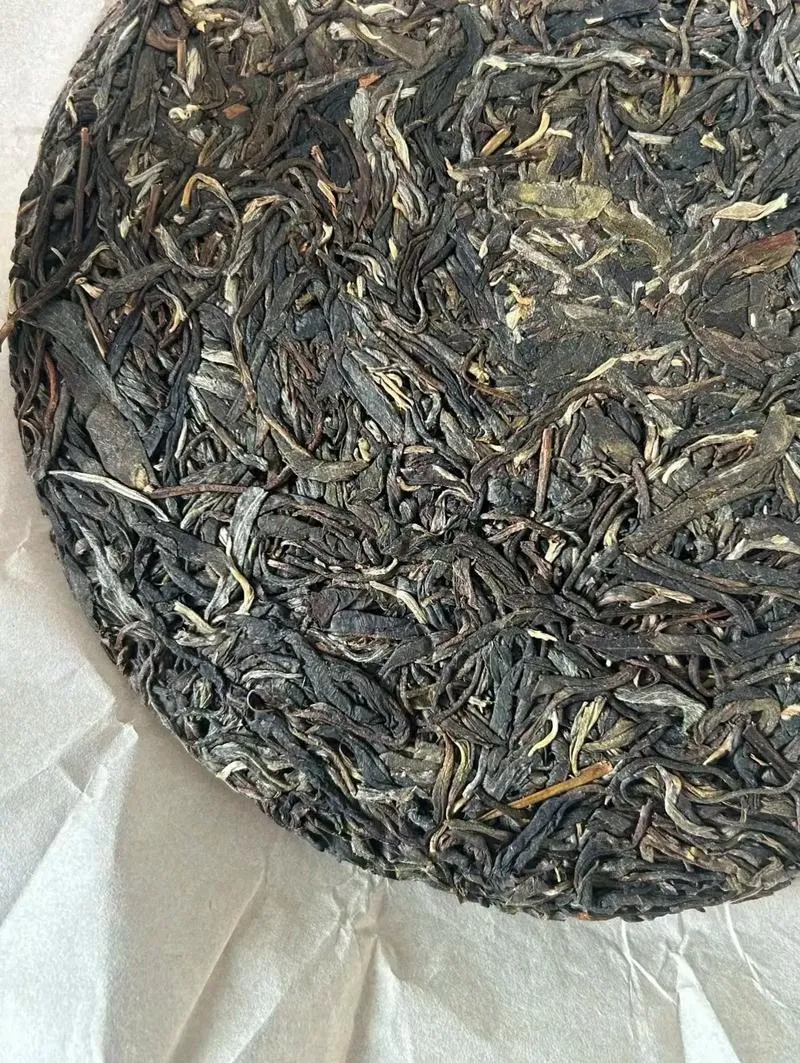
Summary
So, why is tea pressed into cakes?
It is a millennia-spanning practice that integrates survival, science, and aesthetics.
- Historically, it was a "conqueror of space," allowing tea to travel farther.
- Scientifically, it is a "sculptor of time," crafting mellower flavors.
- In the modern context, it is a "promise of quality" and a "vehicle for collection."
It teaches us that tea's life is not static. Pressing is a deliberate choice to set it on a longer, more winding, yet potentially more magnificent path of evolution. When you choose a tea cake, you are not just choosing a package of leaves; you are choosing to participate in a slow dialogue with time.
Remember the Site Owner's words: Drinking loose tea is tasting the gift of the land; storing tea cakes is investing in the art of time. When you understand the complete logic behind pressing, that disc in your hand is no longer just tea—it is a key to the past and a futures contract sent to tomorrow.
