Hello tea friends, it's your webmaster here.
After years of drinking tea, I've noticed something interesting: almost everyone who tries Oolong tea is amazed by its aroma. Tieguanyin's orchid fragrance, Dan Cong's honey orchid scent, Rock tea's "yan yun"… each one is unforgettable.
So I often get asked: "Why is Oolong tea so aromatic? Do they add flavorings?"
Today, I'm going to explain the secret behind Oolong's rich fragrance in the simplest way possible. By the end, you'll understand that this aroma isn't added—it's the result of nature, craftsmanship, and science working together.
1. Bottom Line: Why Is Oolong Called the "Perfume of Teas"?
In one sentence: Oolong's aroma is "forced out" of the tea leaves during processing.
It's not added artificially, nor does it exist fully formed in fresh leaves. Instead, complex chemical reactions during processing generate a huge variety of volatile aromatic compounds. Studies show that Oolong tea contains hundreds of aroma components—far more than green or black tea.
So how exactly is this aroma "forced out"? Let's break it down from three angles: raw materials, processing, and science.
2. Raw Material: Maturity Matters
Many people assume younger leaves are more aromatic, but with Oolong tea, it's the opposite.
Oolong tea requires one bud with three to four leaves, ideally "opposite leaves" where the bud has stopped growing. Why such "old" leaves?
Because tea aroma compounds mainly come from something called "ether extracts"—including aromatic oils, lipids, pigments, and more. These substances either carry aroma themselves or can generate new aroma compounds through hydrolysis and oxidation during processing. And they're mainly stored in mature leaves, with very little in tender buds.
That's why you'll never find Oolong tea made from single buds, and why slightly coarser Oolongs often have more intense aromas.
3. Core Process: Zuo Qing (Shaking Green) — Where Aroma Explodes
If raw materials are the "warehouse" of aroma, then processing is the "key" that opens it. The most critical and magical step in Oolong processing is zuo qing (also called yao qing, or shaking green).
Zuo qing is simple in concept: make the tea leaves move, rub against each other, partially damage the cells, then let them rest—and repeat this cycle multiple times.
This process is typically repeated five to six rounds, lasting over ten hours, with the tea master watching over it all night. Why all this trouble?
Each round of shaking partially damages leaf cells, allowing polyphenols to contact oxygen and oxidizing enzymes, triggering slow enzymatic oxidation. During resting, water and internal compounds redistribute from stems to leaves, providing materials for further transformation.
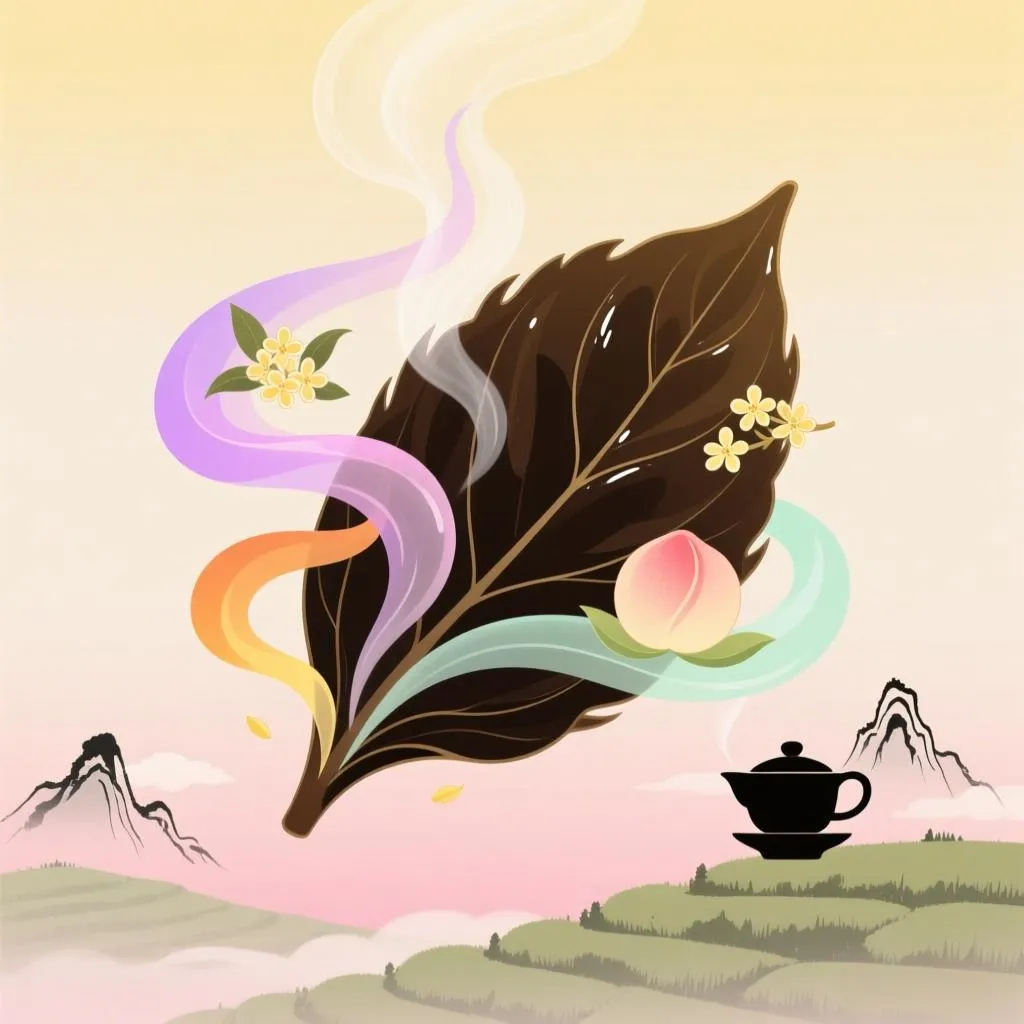
As zuo qing progresses, the aroma evolves: from fresh green notes to orchid-like fragrance, then to osmanthus and fruity notes… This is the layered development of Oolong aroma.
Get zuo qing right, and both aroma and taste succeed; get it wrong, and nothing works.
4. Scientific揭秘: How Is Aroma Actually Generated?
Let's get a bit technical—how are those aromatic compounds actually formed?
Scientists used to believe that tea leaves contain large amounts of "aroma glycosides," which are cut by glycoside hydrolases during processing, releasing free aroma compounds.
But recent research reveals a more fascinating mechanism: Oolong tea aroma formation is mainly due to the tea leaves' "stress response".
What does that mean?
Unlike other tea types, Oolong tea leaves remain alive for a long time during processing and experience multiple stresses:
- Plucking: wounding stress
- Solar withering: drought, heat, UV radiation stress
- Zuo qing: repeated mechanical wounding stress
- Nighttime coolness: low-temperature stress
The research found that combined wounding and low-temperature stress significantly triggers the tea leaves' mechanisms for aroma compound synthesis, leading to massive accumulation of aromatic substances. Examples include:
- Indole (floral notes)
- Jasmine lactone (jasmine-like aroma)
- Nerolidol (floral-fruity notes)
These aroma compounds are essentially the tea leaves' self-defense mechanisms activated under stress. Simply put: the more the leaves are "stressed," the more aroma they produce.
5. Other Steps: Fine-Tuning the Aroma
While zuo qing is the main battlefield, other steps also contribute:
- Solar withering: UV light increases enzyme activity, boosting amino acids and soluble sugars that support aroma formation.
- Cool withering: Allows even redistribution of water and compounds.
- Fixation (kill-green) : High heat deactivates enzymes, "locking in" the aroma while driving off grassy odors.
- Rolling / wrapping: Further breaks cells, mixing compounds to enhance aroma.
- Drying / roasting: Heat boosts sweetness and aroma; charcoal roasting adds unique smoky notes.
6. Summary: Oolong Aroma — A Triumph of Nature and Craft
Why is Oolong tea so aromatic? Let's recap:
- Raw material foundation: Mature leaves rich in aroma precursors.
- Core processing: Zuo qing repeatedly damages leaves, with resting periods allowing layered transformations.
- Scientific essence: Wounding + low-temperature stress trigger the tea leaves to generate hundreds of volatile compounds.
- Final touches: Solar withering, fixation, rolling, and roasting further shape and perfect the aroma.
So next time you sip a wonderfully aromatic Oolong, take a moment to appreciate it. That fragrance carries the tea plant's "struggle for survival," the tea master's sleepless nights, and the marvels of nature and craftsmanship.
As an old tea master once said: "Oolong tea is made by heaven, earth, and human hands".
