Many beginners wonder:
If tea plants are also trees, what really makes them different from ordinary trees? Can any leaf be brewed into tea?
The answer is clear: only tea plants can produce real tea.
Let’s start with a direct comparison.
1. Tea Plant vs Regular Tree: Comparison Table
| Aspect | Tea Plant (Camellia sinensis) | Regular Trees |
|---|---|---|
| Botanical classification | Theaceae family, Camellia genus | Various families and genera |
| Used for making tea | Yes, only official source | No |
| Harvested part | Young buds and young leaves | Mainly for photosynthesis or timber |
| Leaf texture | Soft, juicy, suitable for picking | Thick, fibrous, not for harvesting |
| Chemical composition | Rich in polyphenols, amino acids, caffeine | Lacks tea-specific structure |
| Brewing result | Fresh, sweet, aromatic, complex | Grassy, bitter, or flat |
| Repeated harvesting | Yes, sustainable for years | Not suitable |
| Cultivation method | Pruned to promote new shoots | Grown naturally or for wood |
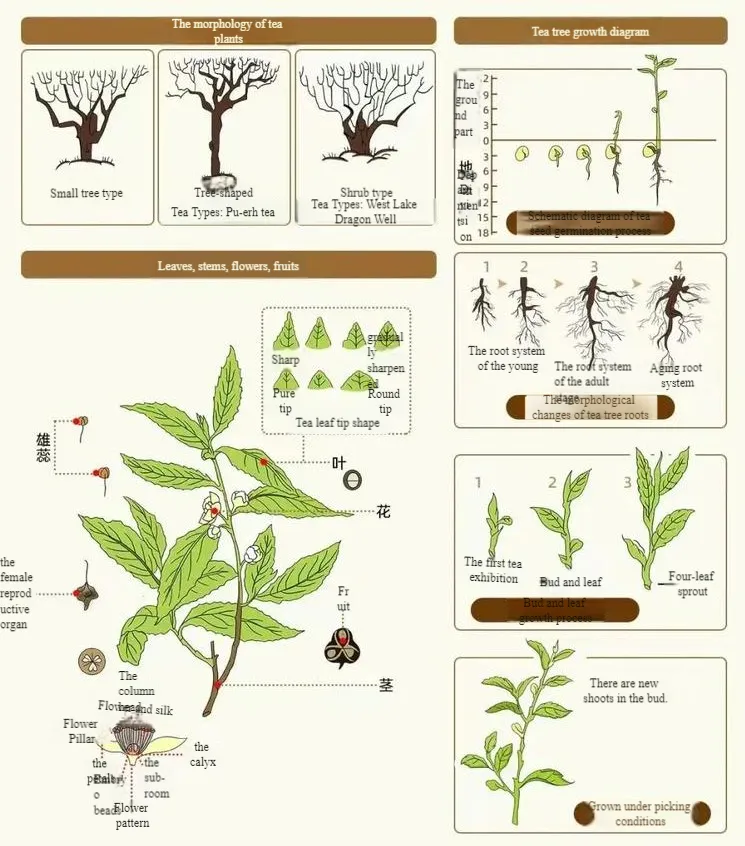
| Plant shape | Mostly bush-type, some tree-type | Mostly tall tree-type |
| Cultural value | Forms complete tea industry & culture | No beverage culture link |
2. Why Only Tea Leaves Can Become Tea
Tea leaves contain a unique balance of:
- Polyphenols
- Amino acids
- Caffeine
- Aroma precursors
Different processing methods then create:
- Green tea
- Black tea
- Oolong tea
- Dark tea
Ordinary leaves:
- Lack these compounds
- Taste flat or unpleasant when brewed
- Have no real processing potential
So tea is not just leaf water —
it is the result of plant chemistry plus processing techniques.
3. Why Tea Plants Can Be Picked Repeatedly
Tea plants have been selectively cultivated to:
- Grow new shoots quickly
- Recover after picking
- Branch more after pruning
That’s why tea gardens look like:
Low, dense bushes instead of forests.
Regular trees, if repeatedly stripped of leaves:
- Lose photosynthesis capacity
- Suffer growth damage
- Cannot be managed as leaf crops
4. Why Some Tea Trees Look Like Big Forest Trees
Some ancient or wild tea plants can grow very tall.
But:
- They are still tea plant varieties
- They simply haven’t been pruned into bushes
- They remain within the same tea species
Height does not determine whether a plant is tea —
species does.
5. Why This Difference Matters to Consumers
Understanding this helps you:
- Avoid misleading “wild leaf tea” claims
- Better judge cultivar and origin importance
- Not overvalue tree size alone
Good tea quality depends more on:
- Variety
- Growing environment
- Farming method
- Processing skill
Not merely whether the plant looks like a big tree.
Site Owner’s Summary
In simple terms:
Tea plants are plants designed by nature and humans for making tea. Other trees are not.
They differ at every fundamental level — from species to chemistry to cultivation goals.
That is why tea can develop such rich styles, aging potential, and cultural depth.
Understanding tea always starts with one basic fact:
real tea only comes from real tea plants.
And that’s where all tea stories begin.
