Many beginners ask:
Aren’t tea plants just trees? What’s the real difference between a tea plant and an ordinary tree? Can any leaf be used to make tea?
The short answer is: No.
Tea plants and regular trees differ fundamentally in species, physiology, chemical composition, and how humans use them.
Let’s break it down.
1. Different Species: Tea Plant Is a Specific Botanical Type
Tea comes from a single species:
👉 Camellia sinensis, in the genus Camellia, family Theaceae.
Most “regular trees” — such as maple, poplar, ginkgo, or camphor — belong to completely different families and genera.
This means:
- Tea plants are specifically suited for tea production
- Other trees simply cannot produce true tea, even if their leaves look similar
Just like grapes make wine but apples do not, this is a species-level difference.
2. Leaf Structure: Designed for Repeated Harvesting
Only the tender shoots of tea plants are used:
👉 one bud with one or two young leaves
Tea leaves are:
- Soft and rich in juice
- Slightly serrated at the edges
- High in amino acids and polyphenols
- Able to regenerate after frequent picking
Regular tree leaves are usually:
- Thicker and more fibrous
- Meant mainly for photosynthesis
- Not suitable for repeated harvesting
In simple terms:
Tea plants are among the few plants that can survive constant leaf picking.
3. Chemical Composition: What Makes Tea Drinkable
What truly makes tea “tea” is what’s inside the leaf.
Tea leaves contain a unique balance of:
- Polyphenols (astringency and aging potential)
- Amino acids (freshness and sweetness)
- Caffeine (stimulating effect)
- Aroma precursors
Different processing methods then create:
- Fresh green tea
- Sweet black tea
- Floral oolong tea
- Aged dark tea
Most regular leaves:
- Do not have this chemical structure
- Taste grassy or bitter when infused
- Some may even be unsafe to drink
So tea is not just “leaf water” —
only tea plant leaves can become real tea through processing.
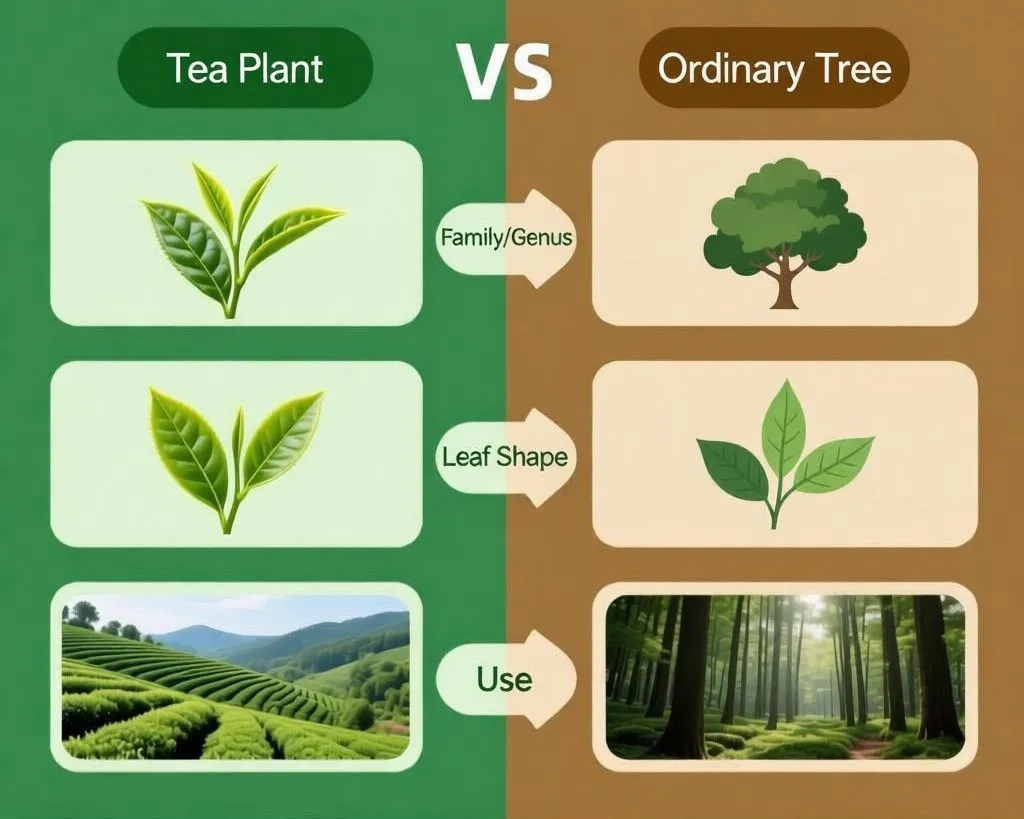
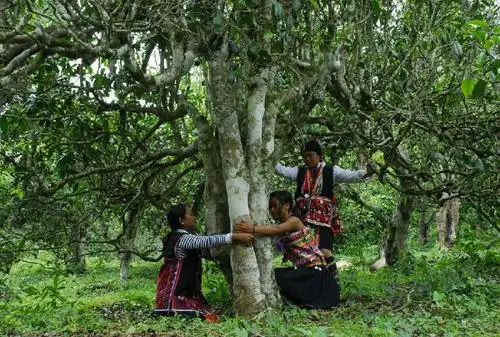
This is tea planted on a large scale. There are also large tea trees like other trees, such as ancient tea trees in Yunnan, as shown in the picture below.
4. Cultivation: Tea Plant Is a Managed Economic Crop
Tea plants are cultivated with one main goal: producing tender leaves.
This includes:
- Regular pruning
- Shaping bushes for easy picking
- Controlling harvest seasons and cycles
Regular trees are usually grown for:
- Shade and landscaping
- Timber
- Environmental protection
So tea plants function more like:
A biological system designed for continuous leaf production.
That’s why tea gardens look nothing like forests.
5. Shape Can Be Similar, but Most Tea Plants Are Bushes
In modern plantations:
- Tea plants are kept at about 1–1.5 meters tall
- Easier for manual or machine harvesting
- More like shrubs than tall trees
Only some wild or ancient tea plants grow into tall trees, sometimes over 10 meters.
But even then:
they are still tea plants, not forest trees.
6. Cultural and Economic Value
Historically, tea plants are deeply tied to human beverage culture:
- Thousands of years of cultivation
- Different regions and cultivars
- Clear grading, trading, and aging systems
Regular trees mainly provide:
- Wood
- Shade
- Ecological benefits
Few plants, like tea, support both:
An agricultural system and a complete global drink culture.
Site Owner’s Summary
Many people think:
“If tea plants are trees, how different can they really be from other trees?”
But the truth is:
Tea plants are not just trees that happen to make tea — they are plants evolved and selected specifically for tea.
From species and leaf structure to chemical composition and cultivation methods, tea plants are fundamentally different from ordinary trees.
When we discuss tea quality, origin, cultivar, or tree age, we are always talking about variations within the same tea species, not between different types of trees.
Understanding this is the foundation for learning about:
- Ancient tree tea
- Plantation tea
- Cultivar-based teas
and for truly understanding where tea comes from.
