Many beginners assume that:
Green tea and black tea come from different tea plants.
In reality, almost all traditional teas come from the same species: Camellia sinensis.
What truly differentiates tea types is how the leaves are processed after picking.
So the six major tea types are, fundamentally:
👉 a classification of processing techniques, not plant varieties.
The key question is always:
Was the tea fermented, and to what degree?
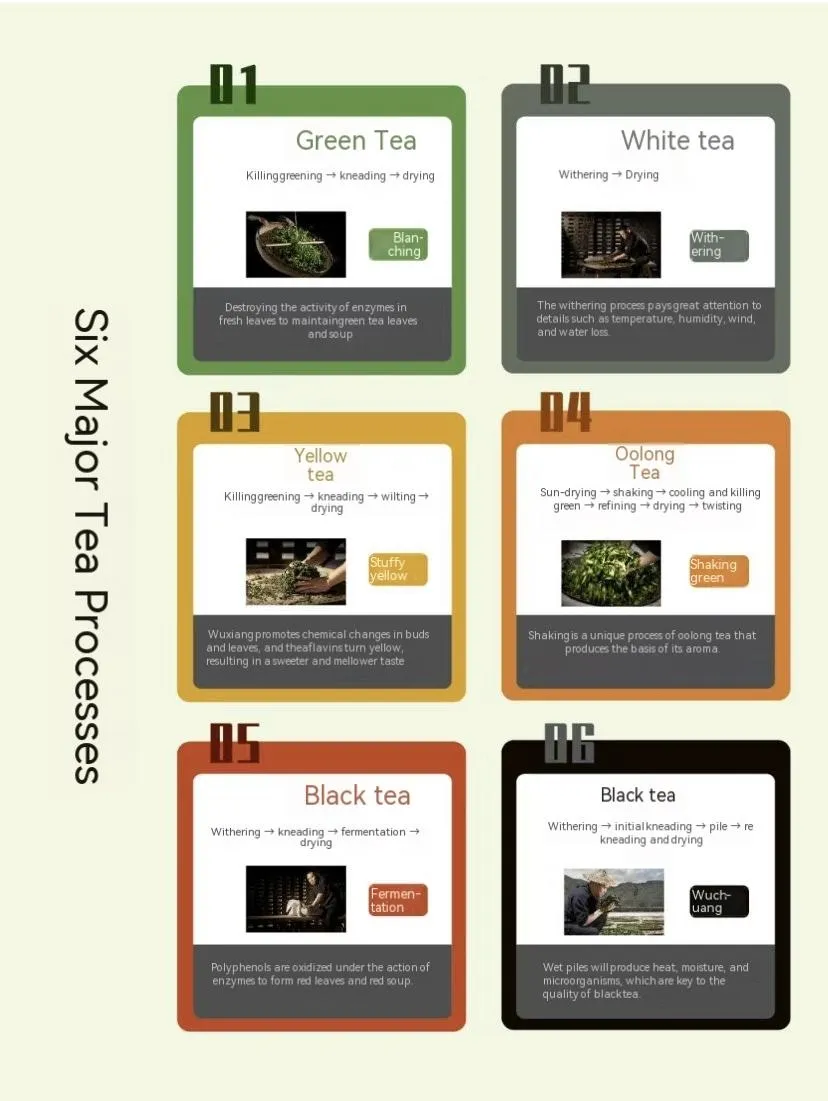
2. The Core Criteria: Fermentation Level and Key Processing Steps
Traditional Chinese tea science focuses on three major variables:
- Kill-green (enzyme deactivation)
- Rolling (cell structure breakdown)
- Fermentation (enzymatic oxidation)
Among these, fermentation is the most critical.
| Tea Type | Fermentation Level | Core Processing Features |
|---|---|---|
| Green | None | Kill-green → Roll → Dry |
| White | Light | Wither → Dry |
| Yellow | Light | Kill-green → Sealing (yellowing) → Dry |
| Oolong | Partial | Wither → Bruise → Kill-green → Dry |
| Black | Full | Wither → Roll → Ferment → Dry |
| Dark | Post-fermented | Kill-green → Pile fermentation → Aging |
Each category represents a stable and reproducible technical system.
3. Why Exactly Six Categories?
Historically, China did not always use this system. Early classifications were based on:
- Shape
- Origin
- Tribute grades
Modern tea classification gradually shifted to processing-based taxonomy, because it is:
- Scientifically consistent
- Technically measurable
- Flavor-predictive
From a processing perspective, tea can only follow a limited number of fermentation paths:
- No fermentation
- Light fermentation
- Partial fermentation
- Full fermentation
- Post-fermentation
Plus the unique “yellowing” process, this naturally forms six stable categories.
Anything more detailed belongs to subcategories or regional styles, not fundamental tea types.
4. The Six Types Also Serve Different Drinking Needs
From a practical standpoint, the six categories exist because they serve different purposes:
- Refreshing and cooling → Green tea
- Gentle and mild → Black tea
- Aromatic and layered → Oolong tea
- Suitable for aging → Dark tea
- Natural and evolving → White tea
Together, they form a complete ecosystem:
- Daily drinking
- Seasonal adjustment
- Long-term storage
This diversity is one reason Chinese tea culture has remained sustainable for centuries.
5. New “Tea Products” Still Fit Within the Six-Type Framework
Modern products like:
- Cold brew tea
- Fruit-infused tea
- Flavored tea bags
are still based on one of the six original tea types.
For example:
- Jasmine tea = Green tea + scenting
- Tangerine Pu-erh = Dark tea + citrus aging
No matter how creative the product, the base tea still belongs to one of the six categories.
6. Why This Matters to Everyday Tea Drinkers
Understanding the six tea types helps you:
1. Choose tea more rationally
You can judge stimulation level, body feel, and suitability for empty stomachs by processing type.
2. Build your own taste profile
Once you know whether you prefer light or rich styles, selection becomes much easier.
3. Avoid marketing traps
Packaging and storytelling may vary, but flavor is still determined by processing logic.
7. Summary: The Six Tea Types Are the Technical Backbone of Chinese Tea
In short:
- ✅ The six tea types are based on processing science
- ✅ Fermentation level is the primary dividing line
- ✅ All famous teas are subcategories of these six
- ✅ Understanding this system is the first step to real tea knowledge
If you are serious about learning Chinese tea,
start with this classification map — everything else builds on top of it.
