Does Drinking Tea Affect Sleep? A Scientific Guide for Restful Nights
Tea friends, this is your site administrator. This is perhaps one of the most frequently asked and most vexing questions about tea: "I want tea in the evening, but I'm afraid it will keep me awake. Should I drink it or not?" Here's the direct answer: Drinking tea can indeed affect sleep, but this is by no means an inevitable outcome. It is a variable that can be completely managed through scientific understanding and technique.
Today, let's clear the air and thoroughly explain the complex relationship between tea and sleep. I'll also provide you with a practical, administrator-tested guide for "drinking tea with peace of mind and sleeping soundly through the night."
Part 1: The Core Conflict: The "Stimulant" vs. The "Sedative" in Tea
Tea's impact on sleep primarily stems from the "battle" between two of its components that have opposing effects:
1. The Primary "Culprit": Caffeine (formerly called Theine)
- Effect: A central nervous system stimulant. It blocks adenosine receptors in the brain that promote sleep, leading to feelings of alertness, mental activation, and increased heart rate. This is the main factor affecting sleep.
- Characteristic: Caffeine has a half-life in the human body of typically 4 to 6 hours. This means if you drink a cup of tea at 4 PM, by 10 PM, about half of the caffeine may still be active in your system.
2. The Key "Mediator": L-Theanine
- Effect: A unique amino acid found almost exclusively in tea. It promotes the production of relaxing alpha brain waves, alleviating anxiety and stress, creating a calming and pleasant sensation. It can also partially counteract the over-stimulation caused by caffeine.
- Characteristic: L-Theanine's relaxing effect is immediate, while caffeine's energizing effect is delayed and prolonged. The balance between these two determines whether the cup of tea is ultimately "calming" or "stimulating."
Part 2: The "Four Key Variables" That Determine the Impact
Whether your sleep is affected depends on the interaction of these four crucial variables:
Variable 1: Personal Physiology – Innate "Caffeine Sensitivity"
This is the deciding factor. People can be roughly categorized into three types:
- Highly Sensitive: Even small amounts of caffeine can cause insomnia and palpitations. It is advised to avoid tea after noon.
- Moderately Tolerant: The majority of people. With reasonable control, moderate evening tea consumption may have little impact.
- Caffeine Insensitive: Can drink strong tea before bed and still fall asleep. However, this doesn't mean the body is unaffected; sleep architecture may still be altered.
Variable 2: The Tea Itself – "Oxidation Level" is the Key Code
The degree of oxidation/fermentation of the tea is a strong indicator (though not absolute) of its caffeine potency and L-Theanine profile:
- Low Oxidation (Green tea, lightly oxidized oolong, young white tea): Typically has higher, more readily available caffeine. Polyphenols (including caffeine) are in a free state, releasing quickly and providing stronger stimulation.
- High Oxidation/Fermentation (Black tea, ripe Pu-erh, aged white tea, well-roasted oolong): Total caffeine content may be similar, but its form is more stable. Furthermore, some L-Theanine and fresh compounds transform into milder substances, making the liquor gentler and less sharp.
Variable 3: Brewing Method – "Time and Temperature" are the Levers
- Steeping Time: Caffeine extraction is fast initially, then slows down. In the first 1-2 infusions, about 70-80% of the caffeine dissolves. Discarding these first infusions ("rinsing" the leaves) can significantly reduce caffeine content in subsequent brews.
- Water Temperature: High temperature (near boiling) facilitates faster and more complete caffeine extraction. Using lower water temperature (e.g., below 85°C / 185°F) can slow down the release of caffeine.
Variable 4: Drinking State – "Empty Stomach" is an Amplifier
On an empty stomach, caffeine is absorbed more quickly, leading to a higher peak concentration in the blood and a stronger, faster impact on the nervous system, increasing the risk of sleep disturbance.
Part 3: The Administrator's "Four Rules" for Sleepless Tea Drinking
Based on the principles above, here is my golden rule set:
Rule 1: Choose the Right Tea (Oxidation Level First)
- Best Evening Choices: Fully oxidized black tea (warm nature, low刺激), post-fermented dark/ripe Pu-erh tea (more stable caffeine, aids digestion), aged white tea / aged oolong (tea character has mellowed).
- Choose with Caution: Unoxidized green tea, young raw Pu-erh, light oxidized Tieguanyin. If you must drink these, make the brew very light.
Rule 2: Use the Right Method (Brewing Technique)
- "Quick In, Quick Out": Use a rapid infusion method. Pour water in and out quickly; avoid prolonged steeping.
- "Discard the Head, Keep the Sweetness": For teas you're concerned about, quickly discard the first 1-2 infusions (about 5-10 seconds each) and start drinking from the third infusion. This removes most of the initial caffeine burst while retaining more L-Theanine, sugars, and sweet compounds in later infusions.
- Lower the Temperature: When brewing the "evening choice" teas, you can moderately lower the water temperature to 90-95°C (194-203°F), which releases aroma while being gentler.
Rule 3: Control Quantity and Timing
- Strictly Control Quantity: For evening tea, 3-5 grams of dry leaves is sufficient. Never overdo it.
- Set a "Cut-off Time": Give your body a "caffeine metabolism buffer zone." It is recommended to stop drinking tea 3-4 hours before bedtime. For example, if you plan to sleep at 11 PM, have your last cup by 7-8 PM.
Rule 4: Pair with a Snack
When drinking tea in the evening, it's best to pair it with a light snack, such as crackers, nuts, or a small pastry. Food can slow down the absorption of caffeine, buffering its impact.
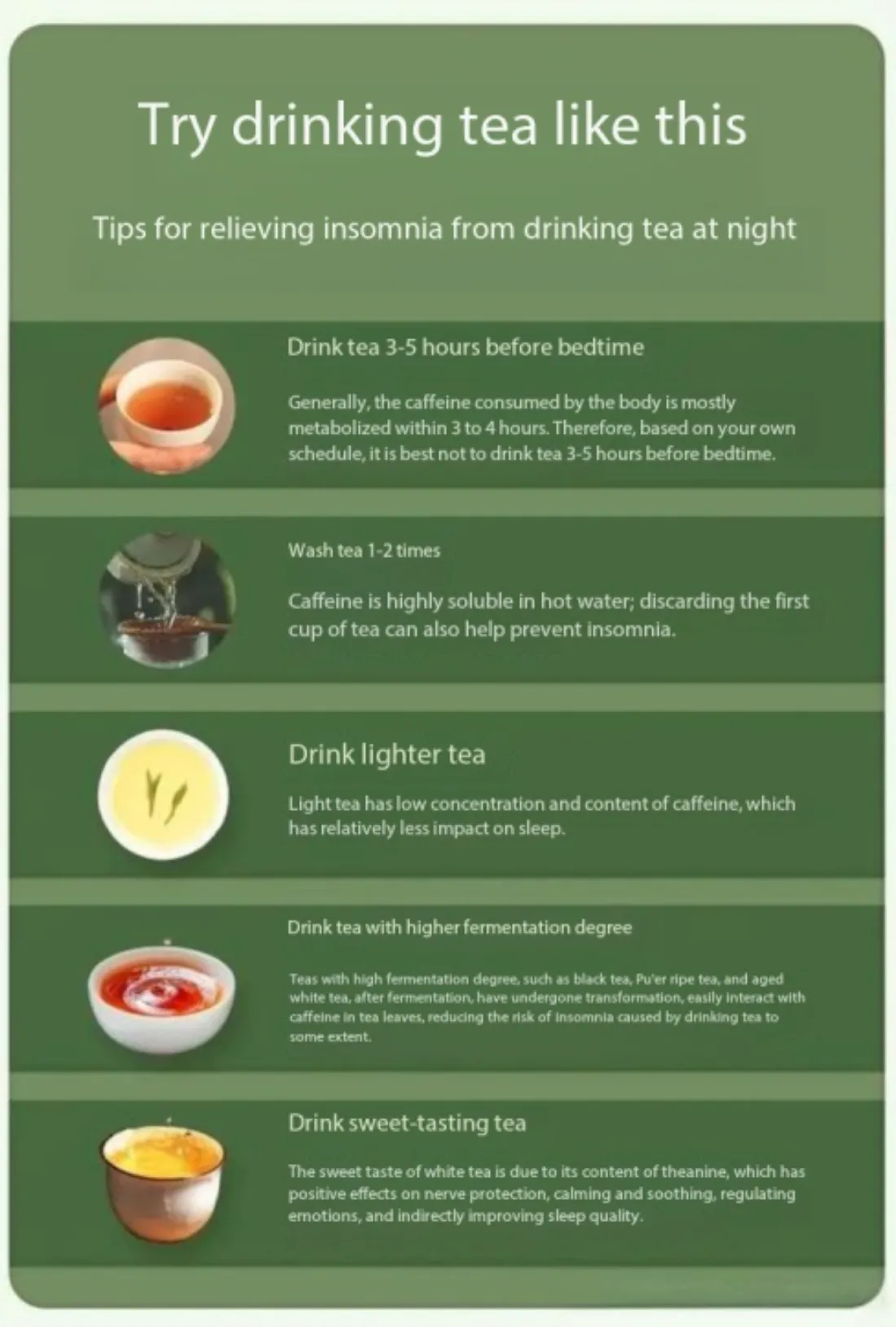
Part 4: IV. Or try these tips for drinking tea at night to alleviate insomnia:
Drink tea 3-5 hours before bedtime:
Caffeine is usually metabolized within 3-4 hours, so stopping tea consumption 3-5 hours before bed can reduce its impact.
Rinse the tea 1-2 times:
Caffeine is easily soluble in hot water, so discarding the first two infusions can reduce caffeine intake.
Drink weaker tea:
Weak tea has a lower caffeine concentration, which has less impact on sleep.
Drink more fermented tea:
Fermented teas such as black tea, ripe Pu-erh tea, and aged white tea, after the tea polyphenols are converted, react with caffeine to reduce the risk of insomnia.
Drink tea with a sweet taste:
Teas containing theanine, such as white tea, help protect the nerves, calm the mind, and indirectly improve sleep quality.
Part 5: Conclusion: Harness with Wisdom, Not Avoid with Fear
Whether tea affects sleep is fundamentally a scientific management issue concerning "quantity, degree, timing, and method," not an absolute prohibition.
Fear stems from the unknown, while control comes from understanding. Once you understand the interplay between caffeine and L-Theanine, comprehend the code of oxidation levels, and master the levers of brewing, you gain the ability to freely navigate between enjoying the pleasure of tea and ensuring restful sleep.
Tea should nourish life, not burden sleep. As your administrator, I encourage every tea friend: Don't avoid food for fear of choking by refusing the quiet moment of evening tea fragrance. Instead, use the knowledge you've gained today to brew yourself a reassuring "evening cup." Bid farewell to a busy day gently amidst the swirling aroma.
May you henceforth enjoy both fragrant tea and deep, restful sleep.
